RightsRecall

iran israel conflict

Iran Israel Conflict: Complete Timeline, Wars, Agreements & Path to Peace

1. Understanding the Iran Israel Conflict The Iran Israel conflict stands today as one of the most complex, multi-dimensional geopolitical rivalries in the modern world. What began as an ideological rupture in 1979 has evolved into a confrontation that involves nuclear brinkmanship, proxy warfare across multiple countries, direct military exchanges, and consequences felt in every […]

Iran Israel Conflict: Complete Timeline, Wars, Agreements & Path to Peace Read More »

Nuclear Non-Proliferation Treaty

Nuclear Non-Proliferation Treaty (NPT): History, Pillars, Failures, and Its Urgent Relevance Today

The Most Consequential Treaty the World Is Failing to Keep Imagine a treaty signed by nearly every nation on earth — 191 states — that carries within it a solemn promise: that nuclear weapons will one day be eliminated from the face of the planet. Now imagine that, more than half a century after that

Nuclear Non-Proliferation Treaty (NPT): History, Pillars, Failures, and Its Urgent Relevance Today Read More »

international peace

International Peace and Security Under the UN Charter: Promises, Progress, and the Path Forward

Why International Peace Remains the World’s Most Urgent Human Right At its core, international peace is not merely a political aspiration — it is a fundamental human right. Without peace, no other right can be meaningfully exercised. The right to life, liberty, education, health, and dignity all crumble under the weight of armed conflict, occupation,

International Peace and Security Under the UN Charter: Promises, Progress, and the Path Forward Read More »

kurdish movement

Quest for Autonomy: The Kurdish Movement in Historical, Political, and Ideological Perspective

The Kurdish Movement The Kurds, numbering over thirty million, constitute one of the largest stateless nations in the contemporary international system. Spread across contiguous regions of Turkey, Iraq, Syria, and Iran, they share a distinct linguistic, cultural, and historical identity but lack a sovereign state of their own. This condition of statelessness is not accidental;

Quest for Autonomy: The Kurdish Movement in Historical, Political, and Ideological Perspective Read More »

Strait of Hormuz

🛢️ Strait of Hormuz Explained: Maritime Law, Control, Size Comparison & Global Impact

🌊 What is the Strait of Hormuz & Why It Matters The Strait of Hormuz is a narrow but critically important waterway connecting the Persian Gulf to the Arabian Sea, lying between Iran and Oman. It serves as one of the world’s most vital maritime chokepoints, through which a significant share of global oil and

🛢️ Strait of Hormuz Explained: Maritime Law, Control, Size Comparison & Global Impact Read More »

Algorithmic Sovereignty

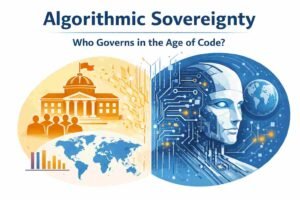
Who Governs in the Age of Code? Exploring Algorithmic Sovereignty

For centuries, sovereignty has stood as the foundational principle of political order. From early modern Europe to contemporary international law, the sovereign state has been understood as the ultimate authority within a defined territory, exercising exclusive control over its population, institutions, economy, and security apparatus. Sovereignty implied autonomy, territorial integrity, legal supremacy, and the monopoly

Who Governs in the Age of Code? Exploring Algorithmic Sovereignty Read More »

Article 21 of Indian Constitution

Article 21 of Indian Constitution — Right to Life & Personal Liberty Explained

Article 21 of Indian Constitution is one of the most important and powerful fundamental rights that protects the life and liberty of every person living in India. It simply means that no one can be deprived of their life or personal freedom unless the law allows it through a fair and just procedure. In easy

Article 21 of Indian Constitution — Right to Life & Personal Liberty Explained Read More »

Article 19 of Indian Constitution

Article 19 of Indian Constitution: Right to Freedom and Personal Liberty

Article 19 of Indian Constitution Article 19 of Indian Constitution is one of the most important pillars of Indian democracy. It comes under the broader Right to Freedom and protects every citizen’s personal liberty through six fundamental freedoms — the freedom of speech and expression, to assemble peacefully, to form associations, to move freely, to

Article 19 of Indian Constitution: Right to Freedom and Personal Liberty Read More »

List of fundamental duties in Indian Constitution

List of Fundamental Duties in the Indian Constitution: Article 51A Explained with Meaning and Importance

Introduction The Indian Constitution is a living document that guarantees Fundamental Rights to its citizens, ensuring freedom, equality, and justice. However, it also recognizes that rights come with responsibilities. To maintain the unity, integrity, and dignity of the nation, citizens must not only enjoy their rights but also fulfill their moral and civic obligations. This

List of Fundamental Duties in the Indian Constitution: Article 51A Explained with Meaning and Importance Read More »

Human Rights in Modern Times

Human Rights in Modern Times: Meaning, Evolution, and Major Challenges of the 21st Century

Introduction Human rights in modern times are at the very heart of global conversations on dignity, freedom, equality, and justice. They serve as the moral and legal framework that defines how individuals should be treated by governments, societies, and even private actors. While the concept of human rights can be traced back to ancient philosophies,

Human Rights in Modern Times: Meaning, Evolution, and Major Challenges of the 21st Century Read More »

Human Right to freedom of religion

The Right to Freedom of Religion: Global Significance, Laws, and Future Challenges

Introduction The Human Right to Freedom of Religion is one of the most fundamental rights recognized in modern democracies and human rights instruments. It upholds each person’s freedom to choose, practice, change, or abstain from religious belief without coercion or discrimination. As societies become more pluralistic, the Right to Freedom of Religion acts as a

The Right to Freedom of Religion: Global Significance, Laws, and Future Challenges Read More »

,
Rights of people to exist

Rights of People to Exist: Meaning, Theories, Discourse and International Legal Frameworks

Introduction The rights of people to exist is one of the most profound and universal principles in human civilization. It lies at the intersection of individual human rights and collective rights of communities or states, encompassing moral, philosophical, and legal dimensions. On one hand, it affirms every individual’s inherent right to life, dignity, and identity.

Rights of People to Exist: Meaning, Theories, Discourse and International Legal Frameworks Read More »

, , ,
Scroll to Top