1971 Indo-Pak War

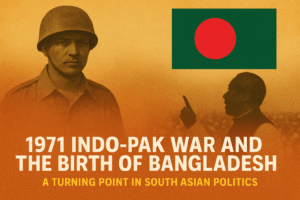
1971 Indo-Pak War and the Birth of Bangladesh: A Turning Point in South Asian Politics

The 1971 Indo-Pak war remains one of the most significant and transformative events in South Asian history. More than just a military conflict, it marked the end of a long-standing internal crisis within Pakistan and gave birth to a new nation, Bangladesh. It also reshaped regional politics, redefined India’s role on the global stage, and […]

1971 Indo-Pak War and the Birth of Bangladesh: A Turning Point in South Asian Politics Read More »

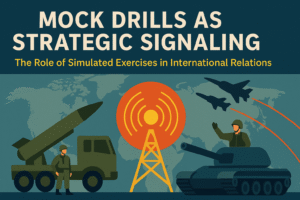
Mock Drills

Mock Drills as Strategic Signaling: The Role of Simulated Exercises in International Relations

Mock Drills In the lexicon of international diplomacy and defense, military and civil mock drills have long transcended their original purpose of preparedness. Today, they serve as a potent tool of strategic signaling in the international system. From NATO’s war games in Eastern Europe to Indo-Pacific joint naval exercises, mock drills often act as choreographed

Mock Drills as Strategic Signaling: The Role of Simulated Exercises in International Relations Read More »

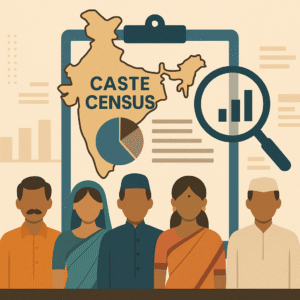
Caste Census

Why Does Caste Still Dominate Indian Politics and Policy? It’s Time to Ask Bigger Questions

When the Union government recently announced that the upcoming Census would include caste enumeration, the country witnessed a wave of celebration, especially from opposition parties and social justice advocates. “Historic,” many called it. Others declared it a political win for the opposition, which had long demanded the move. But amidst the noise of victory, data,

Why Does Caste Still Dominate Indian Politics and Policy? It’s Time to Ask Bigger Questions Read More »

caste census

Revisiting the Caste Census: A Political and Social Imperative in Contemporary India

1. Introduction The demand for a caste census has re-emerged as a central issue in Indian politics and public policy, particularly after Bihar’s 2023 caste survey and the Union Government’s approval of caste enumeration in the upcoming national census. While caste enumeration was a regular feature until 1931, its exclusion in later decades reflects India’s

Revisiting the Caste Census: A Political and Social Imperative in Contemporary India Read More »

Minimum Wage

The Politics of Minimum Wage: Balancing Economic Growth and Social Justice

Beyond Numbers — Minimum Wage as a Human Rights Imperative The minimum wage debate is often trapped in abstract economic models, political soundbites, and corporate boardroom discussions. Yet, at its core, it is a deeply human issue — one that speaks to the dignity of labor, the right to a decent life, and the collective

The Politics of Minimum Wage: Balancing Economic Growth and Social Justice Read More »

Child Rights

Child Rights: From Protection to Empowerment — A Global Call to Action

What Are Child Rights? Child rights refer to the fundamental freedoms and entitlements that must be guaranteed to every child by virtue of their humanity. Recognized across various international, regional, and national frameworks, these rights transcend distinctions of nationality, ethnicity, gender, religion, or socio-economic background. They are rooted in the recognition that childhood is a

Child Rights: From Protection to Empowerment — A Global Call to Action Read More »

women empowerment

Intersectionality Matters: Women with Disabilities and the Struggle for True Empowerment

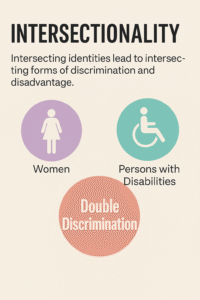
Introduction Despite global progress in gender equality and disability rights, women with disabilities remain among the most marginalized and invisible groups worldwide. These women occupy an intersectional space where gender-based discrimination meets ableism, resulting in “double discrimination” that systematically excludes them from empowerment frameworks. If the objective of women empowerment is to create an equitable

Intersectionality Matters: Women with Disabilities and the Struggle for True Empowerment Read More »

U.S. Reciprocal Tariffs

The Global Ripple: U.S. Reciprocal Tariffs and Their Far-Reaching Impacts​

On April 2, 2025, President Donald Trump stunned the global economic community by declaring what he termed “Liberation Day,” a bold pivot in U.S. trade policy. Through Executive Order 14257, the administration introduced a sweeping set of U.S. reciprocal tariffs—beginning with a universal 10% levy on most imported goods, followed by sharply higher, country-specific “reciprocal”

The Global Ripple: U.S. Reciprocal Tariffs and Their Far-Reaching Impacts​ Read More »

Religious Freedom in India: Constitutional Rights and Democratic Prospects

🕊️ Religious Freedom in India India is one of the most religiously diverse countries in the world. From temples and mosques to churches and gurdwaras, faith plays a central role in the lives of millions. But with such diversity comes the need to protect every individual’s right to believe—or not believe—freely and equally. This is

Religious Freedom in India: Constitutional Rights and Democratic Prospects Read More »

US-Iran Relations Since the JCPOA: Diplomatic Dynamics, Policy Shifts, and Future Trajectories

What is the JCPOA? The Joint Comprehensive Plan of Action (JCPOA), commonly known as the Iran nuclear deal, was a landmark agreement finalized in July 2015 between Iran and the P5+1 countries — the United States, United Kingdom, France, Russia, China, and Germany — along with the European Union. The goal was to ensure that

US-Iran Relations Since the JCPOA: Diplomatic Dynamics, Policy Shifts, and Future Trajectories Read More »

Political Thought Explained: Meaning, Definitions, Origins, and Its Lasting Impact on Society

What is Political Thought? Political thought is the study of ideas, theories, and principles about power, government, justice, and how societies are organized and governed. Political thought is one of the oldest and most important fields of study in human history. It deals with ideas, theories, and principles that help us understand how societies are

Political Thought Explained: Meaning, Definitions, Origins, and Its Lasting Impact on Society Read More »

The French Revolution: A Transformative Epoch in Modern History

Introduction The French Revolution (1789-1799) was a defining moment in the history of human rights, as it laid the foundation for modern democratic principles and individual freedoms. Rooted in the ideals of Liberty, Equality, and Fraternity, the revolution sought to dismantle the oppressive monarchy and establish a government based on the rights of the people.

The French Revolution: A Transformative Epoch in Modern History Read More »

Scroll to Top